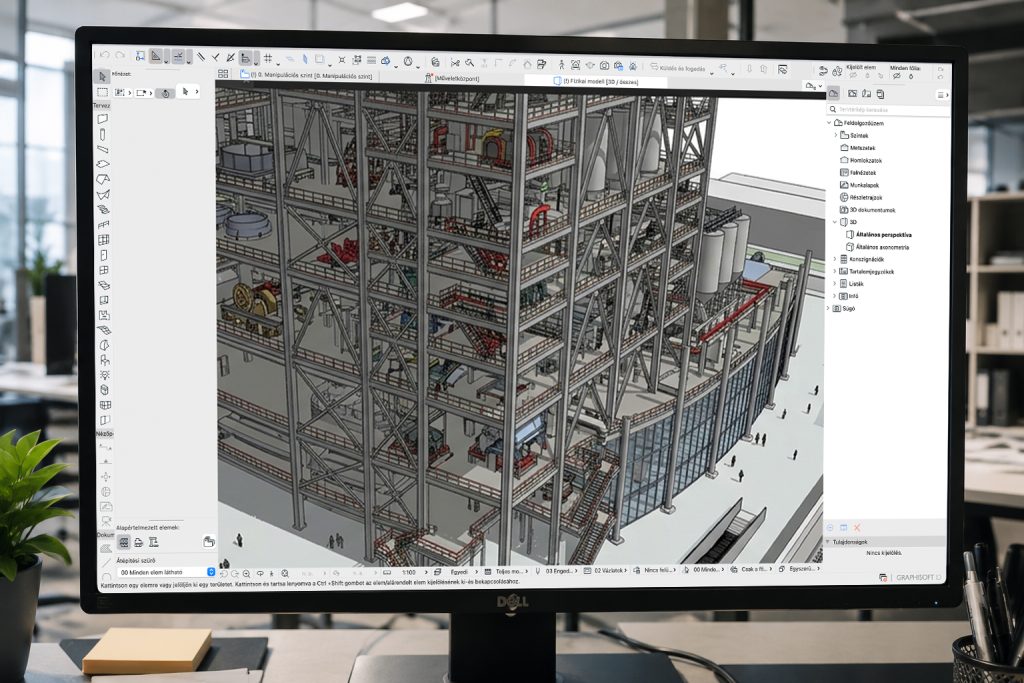

A few weeks ago, Világgazdaság invited me to appear as a guest on their series The Big AI Story, where we discussed how artificial intelligence is transforming the construction industry. You can watch the conversation here:
 The Big AI Story – Construction Industry Episode (YouTube)
You can also read the related article on the Világgazdaság website: A nagy AI-sztori: az AI lesz az új maestro? – így alakul át az építőipar (vg.hu)
I was delighted to be invited and happy to take part, but a 10–15-minute TV format can inevitably cover only a fraction of what we experience every day while working with Brick+Data clients. This post is an opportunity to put some of the points discussed in the studio into a more professional context – not for the camera, but for colleagues and the wider industry.
Visualisation Is the Tip of the Iceberg, Not the Problem
AI first entered the construction industry through visualisation, and that is no coincidence: it is the easiest and most visually impressive application to demonstrate. A few sentences of prompting can produce a photorealistic visualisation within minutes, and the results can indeed be impressive.
But this is not where the construction industry loses money. Visualisation is primarily an aesthetic decision, rather than a technical one. As soon as specific products, precise technical parameters, construction details or compliance requirements come into the picture, the current generation of generative tools is still less reliable – although development in this area is undoubtedly progressing rapidly.
The real, measurable financial losses occur not during the design phase, but in coordination during construction.
Coordination Is the Real Problem – and AI Alone Will Not Solve It
Even today, a medium-sized project typically involves 10–40 different disciplines working in parallel, each using its own software, workflows and version control processes.
In practice, this often means that:
- contractors on site are working from an outdated version of the design,
- discipline models clash because there is no unified common data environment,
- and a significant proportion of comments and corrections still circulate as PDFs sent by email, with issues marked up in red.
This is a structural problem, not an AI problem.
A language model or generative tool cannot do much with a dataset that is actually scattered across spreadsheets, email threads and conflicting model files. AI is not a magic solution; it is a layer that works on top of data. If the underlying data structure is incomplete or inconsistent, the output will be too – only produced much faster and presented with far greater confidence.
This is where BIM is not a competitor to AI, but a prerequisite for it.
A structured, unambiguous, version-controlled data model shared across disciplines is what makes it possible for an automated system to work meaningfully with project information in the first place – whether for clash detection, quantity take-offs or compliance checking.
Automating Compliance Checks – and the Lesson from Singapore
We also discussed the example of Singapore in the studio, where systems have been in use since the early 2000s to automatically check building designs for regulatory compliance based on submitted BIM models.
Technically, this is still not an impossible task today. The bigger question is how willing the industry and the authorities are to adopt a system based on such clear yes-or-no logic.
In Hungary, the practical application of regulations often deliberately leaves room for interpretation. Coordination between engineers and authorities, professional judgement on site and the handling of individual cases still depend largely on human decision-making.
An automated compliance system based on black-and-white logic would remove much of this flexibility – but in return, it would provide greater predictability and speed.
Whether that trade-off is worthwhile is, in my view, more a question of industry policy than technology.
Where Does the Hungarian Market Stand?
If we are realistic, much of the Hungarian construction industry has not yet reached the point where the application of AI is the main bottleneck.
Many companies still do not have a unified, cloud-based platform where the various disciplines can work together using the same data structure. Without this foundation, any AI development will remain an isolated add-on or demonstration tool rather than becoming part of everyday operations.
This is not criticism, but simply the reality: digital maturity and the ability to make effective use of AI are closely connected.
In companies where BIM-based workflows, a common data environment and disciplined version control are already in place, AI-based tools – such as automated quantity take-offs, clash detection and documentation checks – can deliver genuine, measurable time savings.
Where these foundations are missing, they need to be established first.
Summary
The conversation was prompted by AI, but for me the real takeaway is that the order matters when it comes to digitalising the construction industry.
First comes structured, reliable data shared across disciplines. Only then can an AI layer be meaningfully added on top of it.
In the reverse order, AI can become little more than an impressive but superficial layer placed over the same old problems.
Thank you to Világgazdaság for the invitation and for giving me the opportunity to discuss this topic with a wider audience. You can watch the full programme and read the related article using the links above.